


Economic connections and trade played a key role in the formation of early civilizations, shaping not only their level of development but also their political structures, systems of power, and interactions between societies. Ancient states rarely emerged in isolation; their development occurred in the context of resource, technology, and idea exchanges. Understanding this interconnection allows for a deeper insight into why some civilizations became empires while others remained localized cultures.
Economy as the Foundation of Political Power
 In early civilizations, the economy did not exist separately from politics—it was its foundation. Control over resources meant control over people, and therefore control over power. In river valleys such as the Nile, the Tigris, and the Euphrates, economies were initially based on agriculture. In Egypt, pharaohs controlled the grain harvest, which allowed them to finance pyramid construction and organize public works that strengthened the state. Similarly, in Sumer, city-states exchanged grain and crafted goods for wood and stone, which were scarce in the Tigris and Euphrates valleys, enabling rulers to consolidate power through management of trade and resource distribution.
The emergence of surplus products was a turning point for many civilizations. In China, the Shang dynasty exchanged agricultural surpluses for bronze artifacts and precious stones from western regions, strengthening economic and political stability. Control over trade flows became one of the main ways to legitimize power: the ability to provide resources made a ruler powerful and influential.
Trade Networks as a Factor in State Expansion
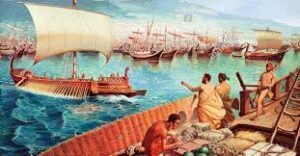
The development of trade inevitably led to territorial expansion and the formation of empires. The Assyrian Empire built its power on controlling trade routes, ensuring the supply of metals and wood for military needs. The Phoenicians, using their maritime skills, spread purple dye, glass, and textiles throughout the Mediterranean, simultaneously disseminating cultural practices and strengthening political ties with neighboring states.
Even the Indus civilization, which lacked a strong militaristic tradition, actively participated in trade with Mesopotamia, sending grain, textiles, and ivory in exchange for metals and precious stones. These trade connections promoted not only economic growth but also cultural exchange, introducing new technologies, measurement standards, and accounting systems.
Controlling trade required infrastructure: roads, warehouses, and security. This stimulated the development of administrative systems. Thus, the economic logic of trade networks directly shaped the political organization of states, creating bureaucratic structures to manage complex exchange processes.
The City as a Center of Trade and Power
With the growth of trade, cities gained special significance. They became hubs where economic, political, and cultural processes intersected. In ancient civilizations, cities served as both markets and administrative centers.
For example, Ur in Sumer concentrated merchants and artisans as well as archives recording economic transactions. Thebes in Egypt controlled the flow of grain along the Nile, reinforcing the pharaohs’ political power. Urban economies were more complex and diverse than rural ones, forming social hierarchies and labor specialization, which enabled the creation of new technologies and crafted goods.
Cities also facilitated the development of standards—weights, measures, currency, and contracts. In the Indus civilization, standard clay measures and seals for marking goods were already in use by the third millennium BCE, simplifying trade and integration into wider networks. Thus, cities became centers of economy, politics, and culture simultaneously.
Economic Dependencies and Political Hierarchy
Trade connected societies but also created dependencies. Resource-rich regions became key players, while territories lacking strategic resources had to integrate into existing networks. For instance, Mesopotamia relied on timber and stone from the Levant, Egypt on jade and resin from Nubia and Sinai, and China on precious stones and metals from western regions.
Economic dependencies formed hierarchies between states. Trade centers could influence peripheral regions and use commerce as a tool of diplomacy or pressure. At the same time, trade could foster peaceful cooperation: states engaged in exchange maintained stability even amidst military tensions.
Trade as a Source of Cultural and Institutional Change
Economic contacts facilitated the spread not only of goods but also of technologies, ideas, and social practices. Writing, which originated in Sumer as a means of accounting for goods, gradually developed into a complex cuneiform system used for administrative and cultural purposes. Religious ideas and theological concepts traveled alongside trade goods, as with the cult of the goddess Ishtar in Mesopotamia, which spread along trade routes.
Trade also promoted standardization: weights, currency, and contractual norms created uniform rules for interactions between societies. This strengthened economic integration and encouraged institutional development, forming legal systems and administrative structures that supported political and social stability.
Table: Examples of Trade’s Influence on Civilizations
| Civilization/Region | Key Resources/Goods | Trade Routes | Influence on Politics and Culture |
|---|---|---|---|
| Sumer | Grain, clay, metal | Intercity, maritime | Strengthened city-states, development of cuneiform |
| Egypt | Grain, papyrus, jade | Nile, Red Sea | Centralized power, diplomatic alliances |
| Hittites | Metals, wood | Through Anatolia | Control of roads, military power |
| Phoenicia | Textiles, purple dye, glass | Mediterranean | Maritime expansion, cultural influence |
| Indus Civilization | Grain, ivory, precious stones | Indus, Mesopotamia | Urbanization, standardization of weights and measures |
Key Takeaways
- Control over the economy was the foundation of political power.
- Trade networks facilitated territorial expansion and empire formation.
- Cities played a central role in trade, governance, and cultural exchange.
- Economic dependencies created hierarchies and diplomatic strategies.
- Trade accelerated the spread of technology, writing, and religious ideas.
Conclusion
Trade and the economy shaped the political, social, and cultural structure of early civilizations. Control over resources and trade flows ensured power, stimulated institutional development, and promoted cultural exchange. Economic connections created both cooperation and dependency between societies, determining political strategies and strengthening centralized authority. Understanding these processes reveals that the economy was inseparable from politics, laying the foundation for future state systems.
